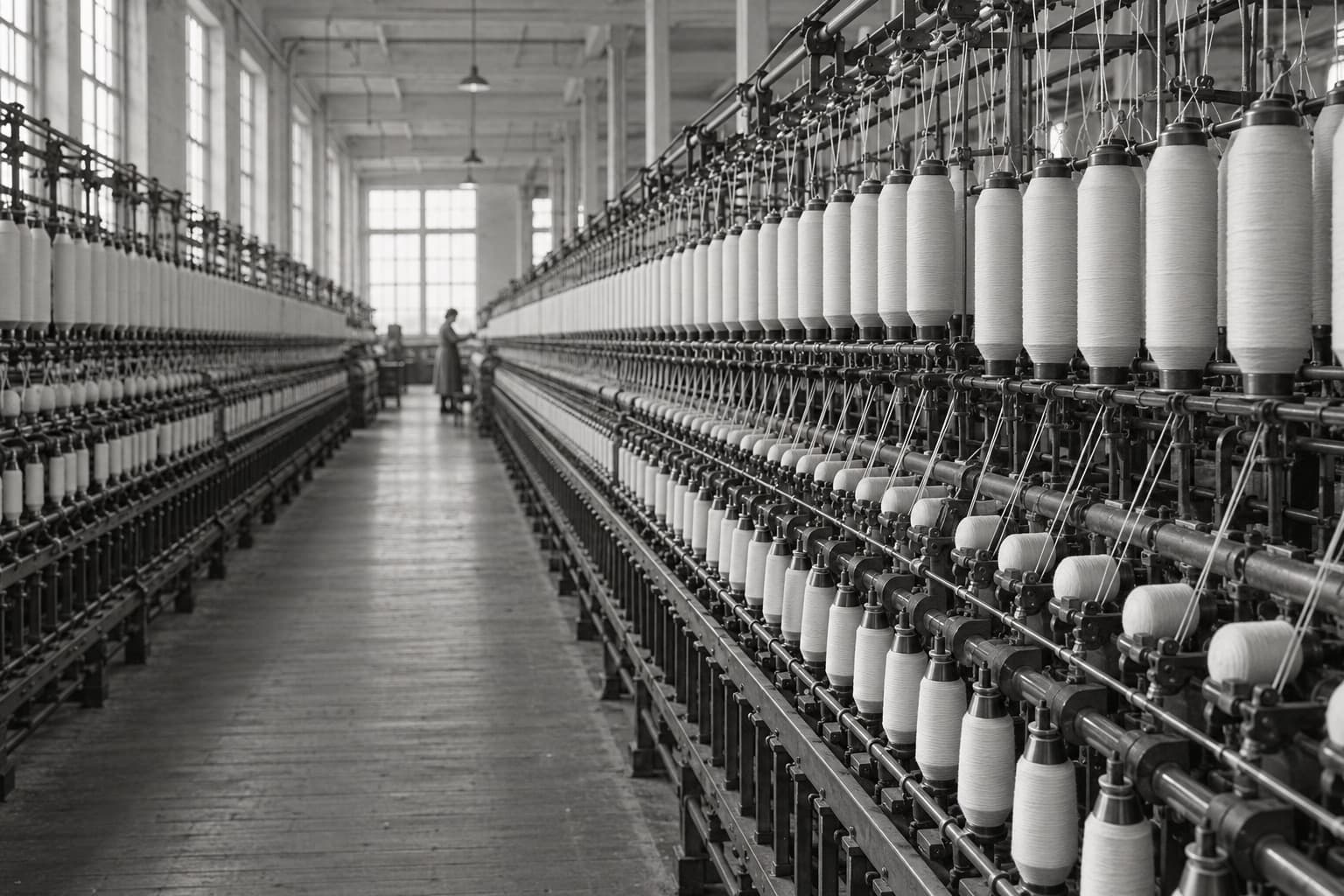
For ring and compact spinning, fiber length and length uniformity matter most, because they set how fine a yarn can be spun; the Rieter K 48 compact spinning machine, for example, calls for cotton longer than 27 mm for counts from Ne 20 to 160. Open-end or rotor spinning accepts shorter fiber and is limited to coarse and medium counts, up to about Ne 40. For rotor spinning, Cotton Incorporated ranks fiber properties as non-lint content, strength, micronaire, length and length uniformity.
Yarn count and fibers per cross-section
English cotton count (Ne) is the number of 840-yard hanks that weigh one pound: the higher the number, the finer the yarn (Ne = 590.54 / tex). A yarn also needs a minimum number of fibers in its cross-section. Cotton Incorporated cites 60 to 80 for ring spinning; for rotor spinning, 100 was the accepted minimum until newer machines brought it down. Finer fiber puts more fibers into the same count.
Ring spinning: carded and combed
On a ring frame, drafting rollers draw out the roving and a traveler running around the ring inserts twist. That drafting needs a minimum fiber length to control each fiber, which is why length and uniformity dominate. Ring yarn is the strongest, softest and finest and covers the widest count range, but it has the lowest productivity and highest cost.
- Carded: no comber; used mainly for coarse and medium counts.
- Combed: the comber removes short fiber, neps and trash; a Rieter E 90 comber runs at 8 to 25% noil. The yarn is more even, softer, stronger and more lustrous, takes less twist, and is the usual choice for fine counts.
Compact spinning
Compact spinning is a ring frame with a device that condenses the fiber strand as it leaves the drafting rollers. According to Cotton Incorporated, compact yarn gains strength, elongation and luster, has less hairiness and takes less twist. The Rieter K 48 spins Ne 20 to 160 from cotton longer than 27 mm.
Open-end or rotor spinning
An opening roller separates the fibers and air carries them into a rotor, usually 31 to 56 mm in diameter, where the yarn is formed. There is no roving frame and no roller drafting, so short fiber works well. According to Cotton Incorporated, dust and trash deposit inside the rotor and hurt both yarn and machine; fiber strength carries directly into yarn strength; coarse fiber puts fewer fibers in the cross-section; and past a certain length, longer fiber adds less and less. Rotor yarn is more even and cheaper, but weaker and harsher to the touch. A Rieter R 37 spins Ne 3 to Ne 40.
Summary by system
| System | Usual counts | Properties that matter most | Yarn traits |
|---|---|---|---|
| Carded ring | Coarse and medium | Length, uniformity, strength | Strong and soft; hairier than compact |
| Combed ring | Medium and fine | Long, uniform, mature fiber | More even, softer, more lustrous |
| Compact | Ne 20 to 160 (Rieter K 48) | Cotton longer than 27 mm | Stronger, less hairy |
| Open-end or rotor | Coarse and medium, up to Ne 40 | Cleanliness, strength, micronaire | Even and economical; weaker |
Frequently asked questions
What micronaire is best for fine counts?
Fine but mature fiber, because more fibers fit in the yarn cross-section. Low micronaire caused by immaturity increases neps. More in what cotton micronaire is.
What is the difference between carded and combed yarn?
Combing adds a step that removes short fiber, neps and trash, so the yarn is more even and stronger and can be spun with less twist.
Is open-end yarn weaker than ring yarn?
Generally, yes. According to Cotton Incorporated, the gap grows with fiber length and can reach 25 to 30% with staple longer than 1-1/8 inches; with shorter fiber it shrinks quickly, and on some coarse counts rotor yarn comes out slightly stronger.
Sources
- Cotton Incorporated: Introduction to Open-End Spinning (TRI 1004)
- Cotton Incorporated: Cotton Spun Yarns for Knit and Woven Fabrics (ISP 1006)
- Rieter: K 48 compact spinning machine
- Rieter: R 37 rotor spinning machine
See also staple length, fiber strength and Max and Safe's cotton qualities.