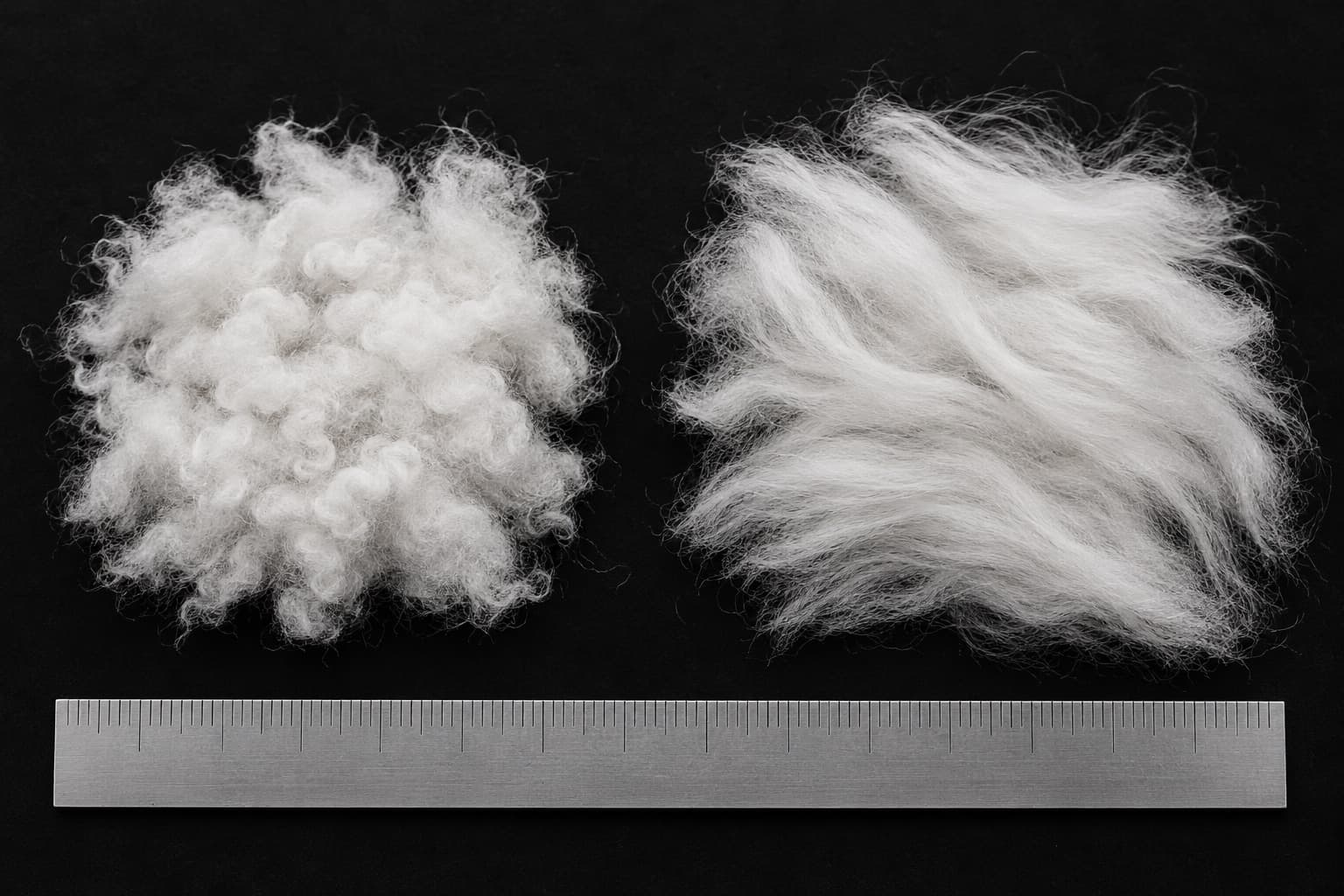
Staple length is the average length of the longer half of the fibers in a sample, known as UHML (upper half mean length). The HVI measures it in hundredths of an inch and USDA also reports it in 32nds of an inch: staple 36 equals 1 1/8 inches, about 28.6 mm. Cotton Incorporated rates fiber of 1.11 to 1.26 inches as long.
What staple means
Each cotton seed produces 13,000 to 20,000 fibers, ranging from about 0.75 inch to almost 1.5 inches long. To describe a bale with one figure, classing uses the UHML: the average of the longer half of the fibers in the sample. In the trade that figure is called staple. Length is a genetic trait of each variety, but water or temperature stress, nutrient deficiencies and harsh ginning can shorten it.
How it is measured
In the HVI, a beard of parallel fibers passes through an optical sensing point. The instrument reads in hundredths of an inch and USDA converts each reading to 32nds using a fixed chart. These are codes 32 to 38 of the Upland chart:
| Code (32nds) | Inches | HVI reading (inches) | Approx. mm |
|---|---|---|---|
| 32 | 1 | 0.99 to 1.01 | 25.1 to 25.7 |
| 33 | 1 1/32 | 1.02 to 1.04 | 25.9 to 26.4 |
| 34 | 1 1/16 | 1.05 to 1.07 | 26.7 to 27.2 |
| 35 | 1 3/32 | 1.08 to 1.10 | 27.4 to 27.9 |
| 36 | 1 1/8 | 1.11 to 1.13 | 28.2 to 28.7 |
| 37 | 1 5/32 | 1.14 to 1.17 | 29.0 to 29.7 |
| 38 | 1 3/16 | 1.18 to 1.20 | 30.0 to 30.5 |
USDA's Upland chart runs from code 24 (0.79 inch or shorter) to 44 (1.36 or longer). For American Pima it uses even codes only, from 40 (1.20 inches or shorter) to 52 (1.48 or longer).
Length classes
Cotton Incorporated groups UHML as follows: short, below 0.99 inch; medium, 0.99 to 1.10; long, 1.11 to 1.26; and extra long, above 1.26. In the 2024/25 U.S. crop, the average by USDA classing office ranged from 35.1 to 37.5 in 32nds.
Length uniformity
The uniformity index (UI) is the mean length of all fibers divided by the UHML, times 100. If every fiber had the same length it would be 100, which never happens. USDA describes it as: very low, below 76.5%; low, 76.5 to 79.4%; average, 79.5 to 82.4%; high, 82.5 to 85.4%; and very high, above 85.4%. Low uniformity points to more short fibers (under half an inch, about 12.7 mm), which make spinning less efficient and less consistent.
Why it matters in spinning
Longer fibers allow finer and stronger yarns to be spun, and improve yarn consistency and spinning efficiency. Length is not read on its own: each bale's HVI record reports it next to uniformity, micronaire and fiber strength, and they are best read together.
Frequently asked questions
What does staple 36 or 1 1/8 mean?
They are the same thing: 36/32 of an inch, which is 1.125 inches or about 28.6 mm. On the HVI it covers readings of 1.11 to 1.13 inches.
What is base staple?
In the USDA loan schedule for Upland cotton, base staple is 34 (1 1/16 inches, about 1.06). In Australia, the base grade used for price quotes uses 36 (1 1/8 inches).
Does ginning affect fiber length?
Yes. Besides variety and weather, the mechanical processes of harvesting and ginning affect length and its distribution, and harsh ginning can reduce staple.
Sources
- USDA AMS: Cotton Classification, Understanding the Data
- Cotton Incorporated: U.S. Cotton Fiber Chart 2024/2025
- Alabama Cooperative Extension System: How to Think About Fiber Quality in Cotton
- Australian Classing Services: Staple Length
See how to read a full HVI report in this guide or browse Max and Safe's cotton qualities.