Micronaire is an airflow measurement that reflects both the fineness and the maturity of cotton fiber. It is reported to one decimal place, for example 4.2. In the USDA loan schedule for Upland cotton, readings of 3.7 to 4.2 earn a premium, 3.5 to 3.6 and 4.3 to 4.9 are the base range, and 3.4 or below or 5.0 or above are discounted.
What micronaire measures
Micronaire does not measure fiber diameter directly: it measures how much fiber surface there is per unit of weight. The more surface a sample has, the more it slows the air passing through it, and the lower the number. That is why there are two routes to low micronaire: a fine-fibered variety, which reads low even when mature, or immature fiber, whose cellulose wall never fully thickened. USDA notes that within a given variety, micronaire and maturity are highly correlated.
How it is measured
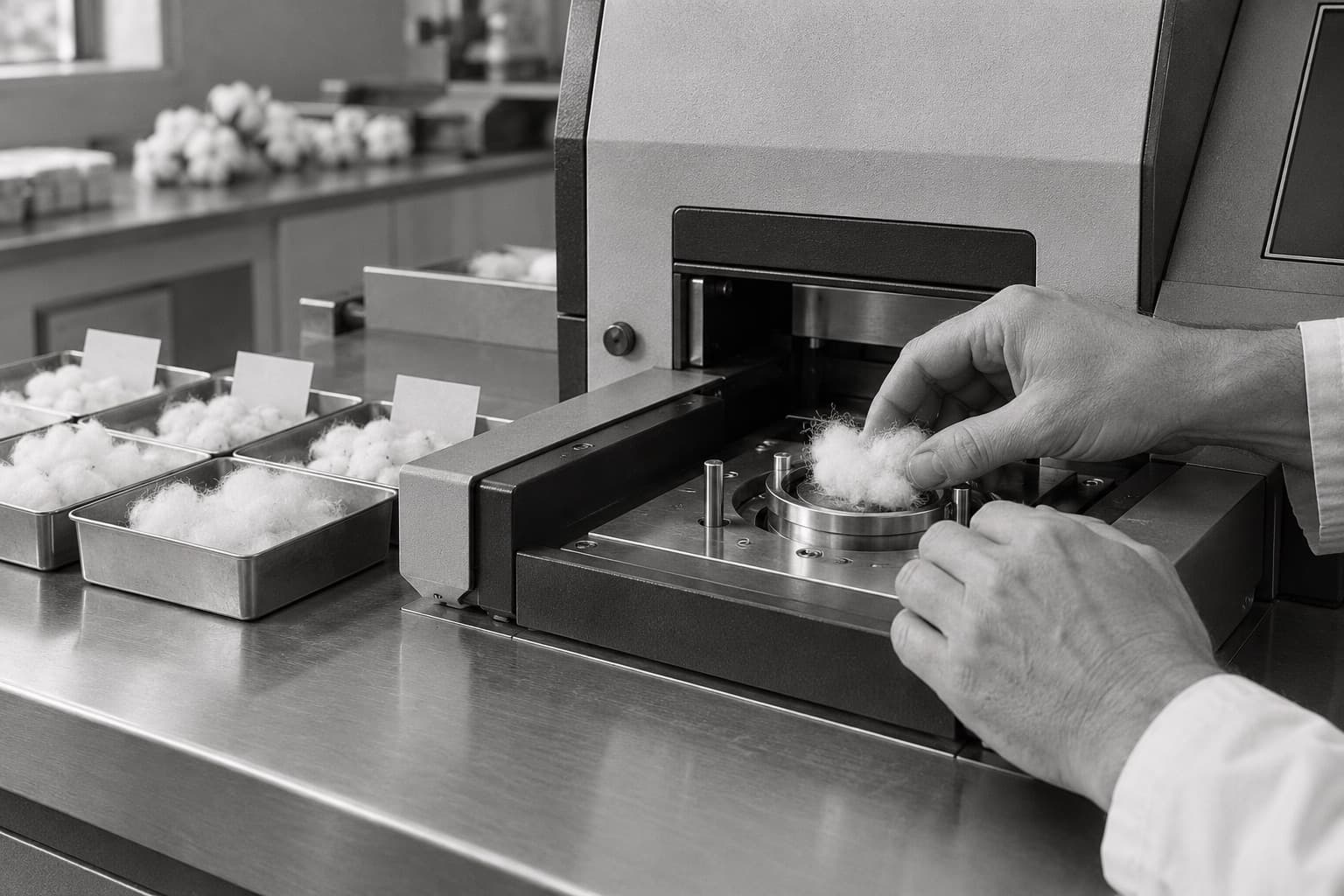
In USDA classing, micronaire comes from the HVI (High Volume Instrument), which measures the fiber's resistance to airflow per unit of mass. The sample is compressed to a fixed volume inside a chamber and a set air pressure is applied. High airflow means little surface per weight and a high micronaire; low airflow means more surface and a low micronaire. The result is reported to the nearest tenth for every bale.
Premium, base and discount ranges
A public reference is the premium and discount schedule USDA publishes every year for Upland cotton loans. For the 2026 crop, the micronaire ranges were:
| Micronaire | Treatment in the 2026 USDA schedule |
|---|---|
| 3.4 and below | Discount |
| 3.5 to 3.6 | Base, no adjustment |
| 3.7 to 4.2 | Premium, only for certain color and leaf grades |
| 4.3 to 4.9 | Base, no adjustment |
| 5.0 and above | Discount |
The amounts change every year and grow as the reading moves away from the base range. In the 2026 schedule, 5.0 to 5.2 carried a discount of 280 points per pound (2.80 cents) and 3.3 to 3.4 a discount of 475 points.
Why it matters in spinning
- Low micronaire from immaturity: immature fiber makes the mix less uniform, which increases breakage and dyeing problems in the mill.
- Low micronaire from fineness: fine fiber that is also mature is highly desirable for fine-count yarns.
- High micronaire: with other fiber properties equal, higher micronaire lowers yarn strength and can limit the count and strength achievable in fine yarns. A study presented at the 2004 Beltwide Cotton Conferences tested this with bales of about 4.0 and 5.2 and blends between them, spun on ring, rotor and vortex systems.
How it relates to other HVI properties
- Length: when fiber ends up shorter, micronaire often rises, because the same cellulose is spread over less length. More in cotton staple length.
- Strength and uniformity: potassium deficiency in the crop reduces maturity and also strength, length and uniformity. More in cotton fiber strength.
Frequently asked questions
What is the ideal micronaire?
There is no single value; it depends on the yarn and the mix. As a reference, the USDA schedule pays a premium for 3.7 to 4.2 and discounts 3.4 and below and 5.0 and above.
Does low micronaire always mean fine fiber?
No. It can come from a fine-fibered variety or from immature fiber, and the number alone cannot tell them apart. Knowing the variety helps, because each variety has a typical micronaire when it matures normally.
What causes high or low micronaire?
The most common cause of low micronaire is a season cut short by frost, disease or early defoliation. High micronaire usually comes from heat or water stress, which make the plant shed bolls and concentrate cellulose in the ones that remain.
Sources
- USDA AMS: Cotton Classification, Understanding the Data
- USDA FSA: 2026-crop Upland cotton premiums and discounts
- National Cotton Council: Cotton Physiology Today, micronaire
- Beltwide Cotton Conferences 2004: Micronaire Performance Comparison
See how to read a full HVI report in this guide or browse Max and Safe's cotton qualities.