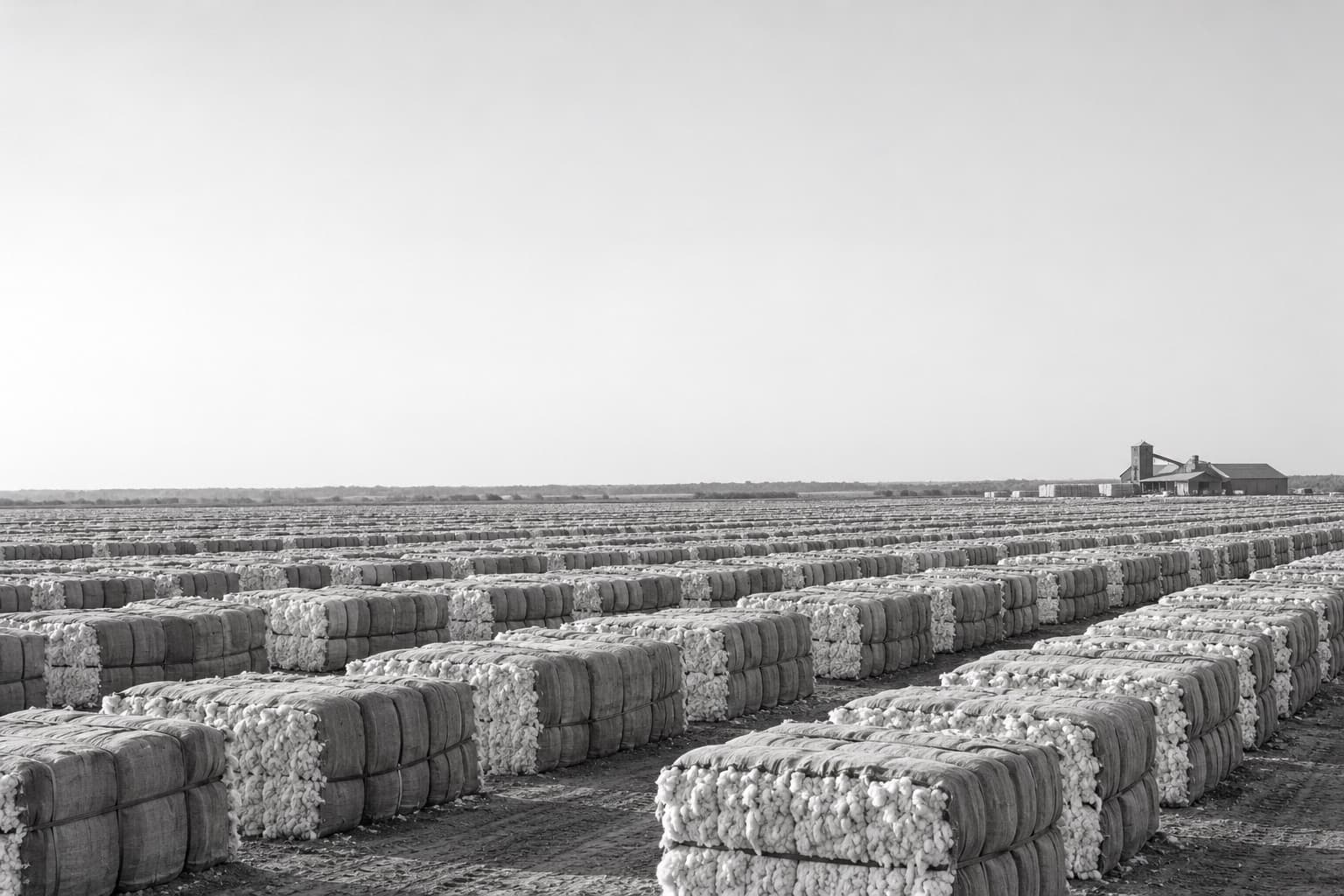
A U.S. cotton bale averages about 491 pounds net (223 kg): 491.5 lb for the 2025 crop, according to USDA. Statistics use a conventional 480-lb bale (217.7 kg). The standard universal density bale measures roughly 54 to 55 × 20 to 21 × 33 inches (1.40 × 0.53 × 0.84 m) and takes up about 0.48 m³.
Net weight, gross weight and the statistical bale
- Net weight: the weight of the lint alone, without packaging. USDA reports a national average of 491.7 lb in 2023, 490.5 lb in 2024 and 491.5 lb in 2025. By state, the 2025 averages ran from 485 to 498 lb.
- Gross weight: net weight plus tare, meaning the bagging and the ties. Official tare ranges from 2 to 7 lb (0.9 to 3.2 kg) depending on the materials.
- The 480-lb statistical bale: a conversion unit. USDA ginning reports convert physical (running) bales into equivalent 480-lb bales, so a production figure "in bales" does not count actual bales.
Universal density bale dimensions
Approximate values from the National Cotton Council for a universal density bale pressed at the gin:
| Measure | U.S. units | Metric |
|---|---|---|
| Reference net weight | 500 lb | 226.8 kg |
| Length | 54 to 55 in | 1.37 to 1.40 m |
| Width | 20 to 21 in | 0.51 to 0.53 m |
| Average thickness (at the bulge) | 33 in or less | 0.84 m or less |
| Volume | 17 ft³ | 0.48 m³ |
| Minimum density | 28 lb/ft³ | 449 kg/m³ |
"Universal density" means the bale is compressed at the gin to at least 28 pounds per cubic foot. Since 2023, the U.S. industry's bale packaging specifications describe only this bale type. It is tied with PET plastic straps or 6 or 8 wires and covered with approved materials such as woven polypropylene, polyethylene film or cotton bagging. The NCC notes that these values are approximate and that normal variation between bales is expected.
How each bale is identified
Every bale carries a Permanent Bale Identification (PBI) tag with a 12-digit number and a barcode:
- The first 2 digits identify the USDA classing office.
- The next 3 identify the gin.
- The last 7 identify the bale.
The classing samples carry the same number. HVI results are linked to it in USDA's national database, where the owner of the cotton or an authorized agent can look them up. In the field, each module also carries a number that ties it to the producer, field and variety.
How bales are sampled for classing
- A licensed sampling agent, usually the gin or warehouse working under USDA supervision, cuts at least 4 ounces (115 g) from each side of the bale, about 8 ounces (230 g) in total.
- The packaging specifications recommend taking the sample before the bale is covered, for example inside the press box. If the bagging is cut, the hole must be patched before the bale ships from the warehouse.
- At the classing office, samples are conditioned to a standard moisture and run through HVI, which measures length, uniformity, strength, micronaire, color and trash. At the peak of the season, USDA classes up to 2 million bales a week.
To read those results, see how to interpret HVI reports.
Frequently asked questions
How much does a cotton bale weigh in kilograms?
About 223 kg net on average (491.5 lb for the 2025 U.S. crop). The 480-lb statistical bale equals 217.7 kg, and the NCC's 500-lb reference value equals 226.8 kg.
Does a Pima bale weigh more than an Upland bale?
Barely. For the 2025 crop, Pima bales averaged 494.1 lb net and Upland bales 491.4 lb. The differences between the two are in the fiber, not the bale (see Upland vs Pima cotton).
How many 480-lb bales is one actual bale?
Because a physical bale averages about 491 lb, 1 million actual bales equal roughly 1.02 million statistical 480-lb bales.
Sources
- USDA NASS, Cotton Ginnings 2025 Summary
- National Cotton Council, U.S. Cotton Bale Dimensions
- JCIBPC, 2026 bale packaging specifications
- Cotton Incorporated, The Classification of Cotton
To see what happens before the bale press, read what is cotton ginning, or browse Max and Safe's qualities.