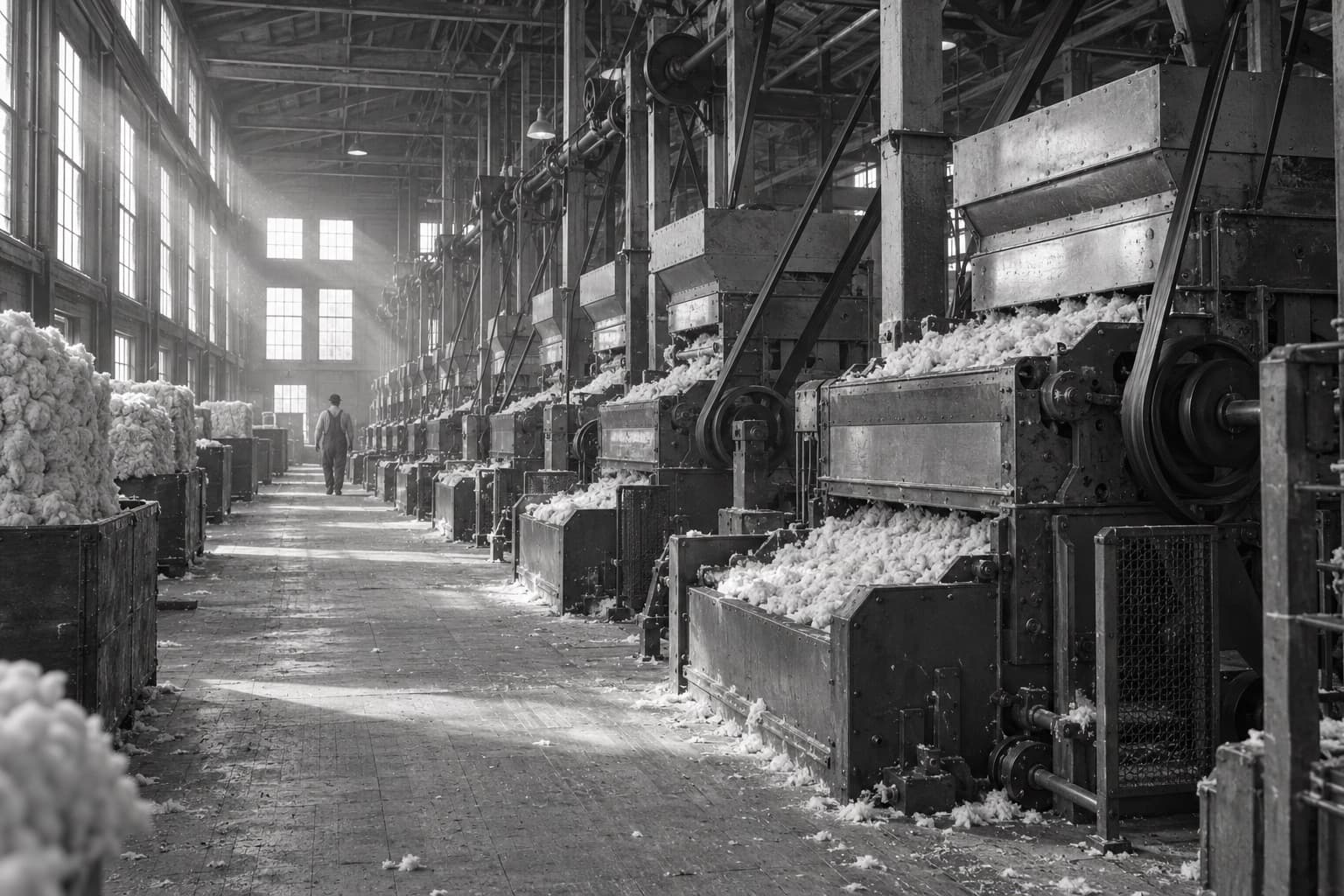
Cotton ginning is the process that separates the fiber (lint) from the cottonseed. A gin takes seed cotton, dries and cleans it, separates lint from seed, cleans the lint and presses it into bales. Spindle-picked seed cotton typically yields about 35% lint; stripper-harvested cotton yields 25% to 30%.
What a gin does, step by step
- Drying: hot air lowers moisture so cleaning works. Dryers should run below 350 °F (177 °C), and the recommended lint moisture for ginning is 6 to 7%.
- Seed cotton cleaning: cylinder cleaners and stick machines remove leaves, burs and sticks.
- Ginning: the gin stand separates the lint from the seed.
- Lint cleaning: removes fine trash and seed-coat fragments.
- Pressing: the lint is pressed into bales of about 500 lb (227 kg). More in cotton bale weight and size.
Lint turnout
USDA-ARS researchers put typical lint turnout at about 35% for picker-harvested cotton, 30% for stripper-harvested cotton with a field cleaner and 25% for stripper-harvested cotton without one. So a metric ton of picked seed cotton gives about 350 kg of lint; the rest is seed and trash. The gap comes mostly from trash: stripper cotton carries more foreign matter.
Saw ginning vs roller ginning
| Aspect | Saw gin | Roller gin |
|---|---|---|
| How it separates | Circular saws pull the lint between ribs; the seed cannot pass | A roller holds the lint against a stationary knife while a rotary knife knocks the seed off |
| Use in the U.S. | Upland | Pima and other ELS |
| Effect on fiber | The saw picks at the lint on each seed 30 to 40 times | Gentler |
| Capacity | High | Rotary-knife gins run at about one-fifth the rate of a saw gin of the same width; high-speed roller gins (since about 2005) match it |
Roller-ginned Upland averages two 32nds of an inch longer, two points higher in uniformity and two points lower in short fiber than when saw ginned.
Lint cleaning: better grade, less fiber
Saw-type lint cleaners remove trash and improve leaf grade, but they break fibers, create neps and remove some good fiber:
- The first lint cleaner cut HVI length by 0.4 mm, lowered uniformity by 0.7 points and raised short fiber content by 0.8 points; the second took off another 0.2 mm.
- For every 500 lb (227 kg) of lint leaving the gin stand, the first lint cleaner removes on average 19.6 lb (8.9 kg) of material and the second 8.1 lb (3.7 kg). With picker cotton, 25% to 30% of that material is fiber.
- Air-jet lint cleaners do little fiber damage but remove less.
So the goal is the minimum cleaning needed for an acceptable leaf grade: discounts for low leaf grades are large, and premiums for better ones are small.
What happens to the cottonseed
- In the United States, each 500-lb bale of lint comes with an average of 696 lb (316 kg) of seed. Cottonseed accounts for 15% to 25% of the crop's value.
- Crushed at an oil mill, it yields by weight roughly 46% meal, 25% hulls, 16% oil and 10% linters, the short fuzz left on the seed after ginning.
- Only about 35% of U.S. cottonseed is crushed; the other 65% is fed whole to dairy cattle.
Frequently asked questions
Is ginning the same everywhere?
The separation is done by saw or roller gins, but the amount of cleaning varies. A 2018 Cotton Ginners Handbook chapter, citing ICAC and USDA figures, notes that 60% to 65% of the world's cotton is still hand-picked, so it needs far less drying and cleaning than machine-harvested cotton.
Why is Pima roller ginned?
Because saws damage extra-long staple fiber, which is what makes Pima valuable. Ever since saw gins appeared in the 1790s, extra-long staple cottons have been roller ginned. Compare both in Upland vs Pima cotton.
Can a gin improve fiber quality?
Only partly. It can remove trash and improve leaf grade, but it cannot make the fiber longer or stronger, or improve the color itself; excessive drying or cleaning can shorten it.
Sources
- USDA-ARS, Wanjura et al., Gin Turnout and Fiber Quality, 2011
- Cotton Ginners Handbook, Roller Ginning, 2017
- Cotton Ginners Handbook, Effects of Gin Machinery, 2018
- Cotton Ginners Handbook, Cottonseed Air-Handling and Storage, 2018
To see how each bale is measured, read how to interpret HVI reports or browse Max and Safe's qualities.