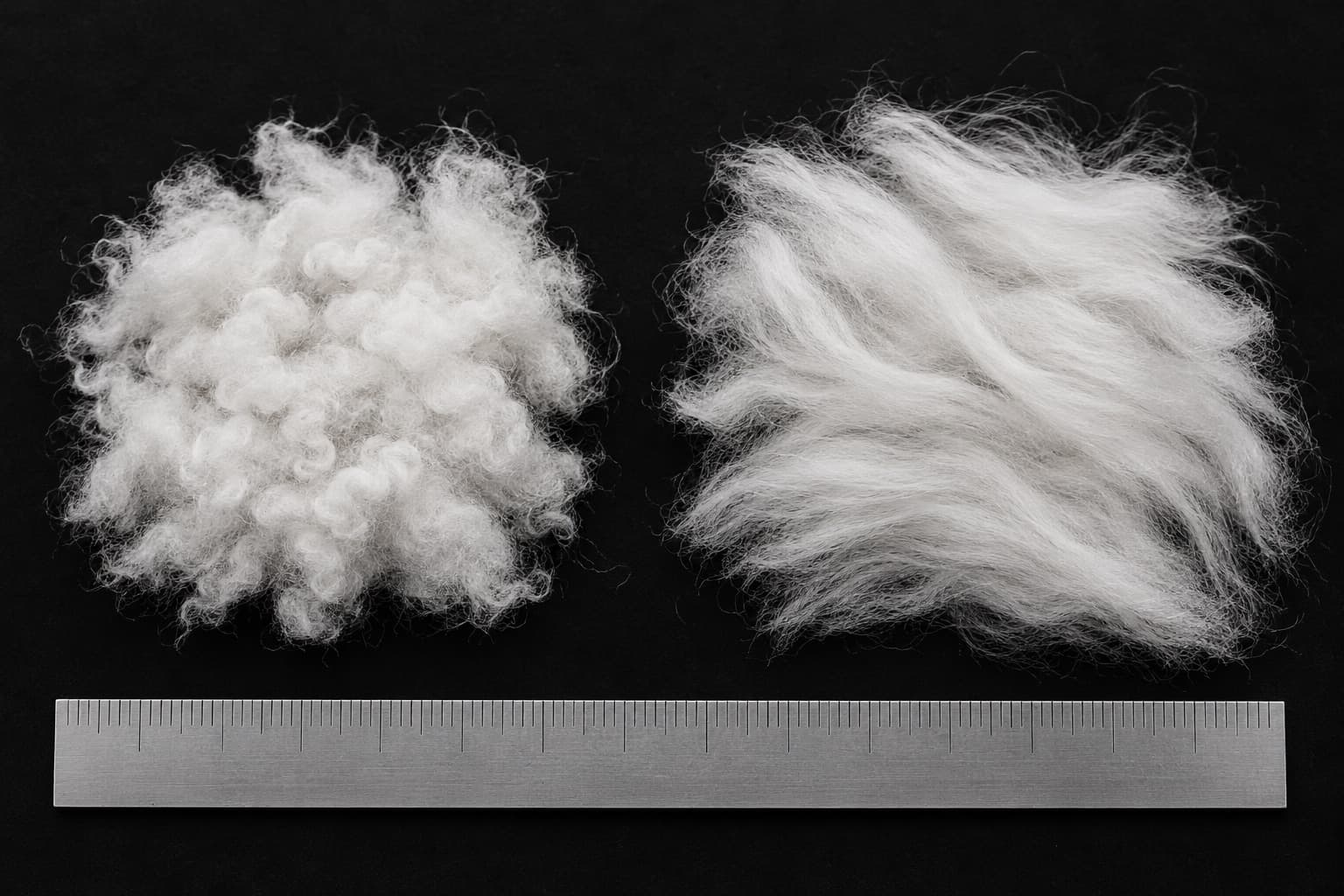
Upland (Gossypium hirsutum) and Pima (Gossypium barbadense) are two different cotton species. Upland is general-purpose cotton and makes up more than 95% of U.S. production; Pima is an extra-long staple (ELS) cotton. In the 2024 U.S. crop, Pima averaged 36.6 mm in length and 43.0 g/tex in strength, against 28.7 mm and 30.2 g/tex for Upland.
Two species, not two quality grades
Upland is native to Mexico and Central America; Pima comes from a species of South American origin. Fiber length and strength are largely set by variety, so a very good Upland does not become Pima: they are different genetics, ginned and classed separately. Upland is saw ginned and Pima is roller ginned, and USDA uses its own color standards for Pima because the fiber is naturally a deeper yellow.
Side-by-side comparison
Averages for the 2024 U.S. crop from USDA classing (bales classed through March 27, 2025):
| Property | Upland | Pima |
|---|---|---|
| Species | G. hirsutum | G. barbadense |
| Fiber length | 1.13 in (28.7 mm) | 1.44 in (36.6 mm) |
| Strength | 30.2 g/tex | 43.0 g/tex |
| Length uniformity | 81.5% | 86.3% |
| Micronaire | 4.4 | 3.8 |
| Bales classed | 13.58 million | 451,000 |
| Ginning method | Saw | Roller |
On Cotton Incorporated's scale, fiber at 31 g/tex or above already counts as "very strong"; Pima averages above 40. Cotton Incorporated puts Pima length at 1 1/4 to 1 9/16 inches (31.8 to 39.7 mm). Pima's lower micronaire points to a finer fiber, although micronaire reflects fineness and maturity together (see what is micronaire).
How much of each is grown
- In the United States, Pima was 3.2% of the bales classed from the 2024 crop: 451,000 of 14.03 million.
- Worldwide, ICAC estimated that extra-fine cotton, the category that covers Pima and other ELS cottons, was only 1.3% of production in 2020/21. The United States led it with an estimated 121,000 tonnes, against about 58,000 for Egypt.
- According to ICAC, extra-fine cotton carries higher input and labor costs than medium-staple cotton.
Uses in spinning
Fiber length affects yarn strength and evenness, spinning efficiency, and how fine a yarn can be spun. That is why Pima goes into fine yarns and higher-value fabrics, while Upland, by sheer volume, supplies most of what spinning mills consume (see cotton for ring and open-end spinning). ICAC notes that better Upland quality and spinning technology now allow finer counts to be spun without extra-fine cotton. For how Pima shows up in the finished fabric, read Pima cotton benefits.
Supima, Egyptian and ELS: what each name means
- ELS (extra-long staple): the trade category for the longest fibers. In the United States it refers to American Pima.
- Supima: a registered trademark for ELS cotton grown in the United States. To carry it, a product must come through a licensed supply chain.
- Pima on a label: according to Supima, retail "Pima" is sometimes used as a generic word for "better" cotton, with no guarantee of extra-long staple.
- Egyptian cotton: names the country of origin, not a fiber length. Egypt grows both extra-long and long-staple varieties; according to Supima, most of it is not extra-long staple.
Frequently asked questions
Is Pima more expensive than Upland?
Yes. ICAC reported that in 2013 the American Pima quote was twice that of shorter-staple cotton, and that since 2018 its ratio to the Cotlook A Index has narrowed to 1.73.
Where is Pima grown in the United States?
In California, Arizona, Texas and New Mexico. California dominated the 2024 crop with 355,000 of the 451,000 Pima bales classed.
Why is Pima roller ginned?
Because roller ginning handles the fiber more gently and better preserves its length. We explain it in what is cotton ginning.
Sources
- USDA AMS, 2024 crop quality summary
- Cotton Incorporated, The Classification of Cotton
- ICAC, Extra-Fine Cotton Update, 2020
- Supima, frequently asked questions
To compare fiber properties in detail, see how to read HVI reports and Max and Safe's qualities.