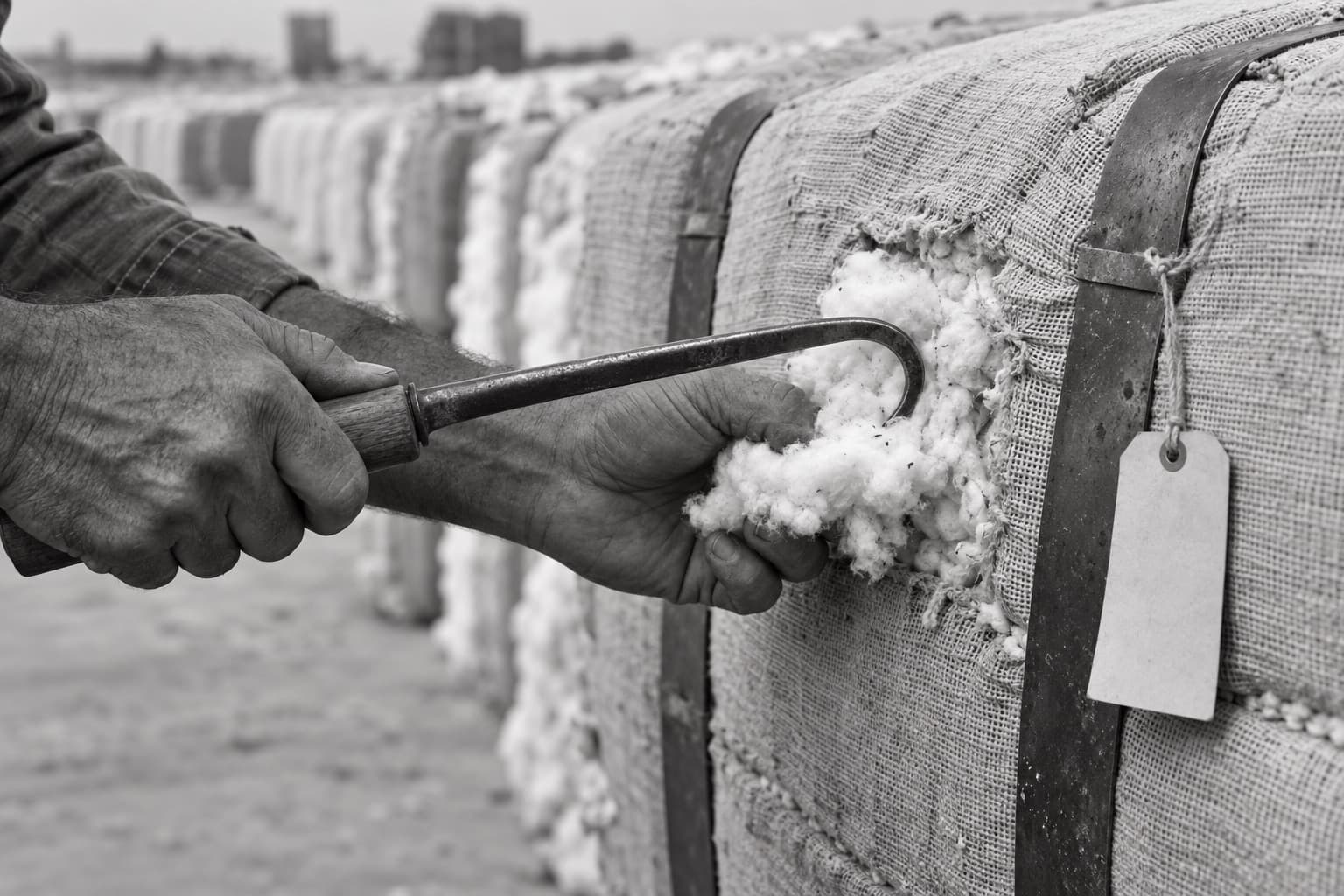
A cotton price has two parts: the ICE Futures U.S. Cotton No. 2 contract, quoted in US cents per pound for a Strict Low Middling, 1-2/32 inch base quality, and a basis that buyer and seller negotiate in points above or below a futures month. The basis reflects the lot's quality, origin, freight and delivery terms; in on-call contracts, the futures price is fixed later. For cotton traded between countries, the benchmark for physical prices is the Cotlook A Index.
ICE Cotton No. 2 futures
- Contract: 50,000 lb net of US-origin cotton, with physical delivery at Galveston, Houston, Dallas/Fort Worth, Memphis and Greenville/Spartanburg.
- Quotation: cents and hundredths of a cent per pound. One point is 1/100 of a cent, worth 5 dollars per contract.
- Months: March, May, July, October and December.
- Base quality: Strict Low Middling, staple length 1-2/32 inches (1-1/16).
Although it is a price for US cotton, the market uses it to hedge cotton from many other origins, which is one reason international prices move together.
Basis and on-call contracts
A physical bale is agreed as futures plus or minus a basis, in points on a specific month: for example, 500 points on March means 5 cents per pound above March futures. The basis covers the lot's quality relative to the contract base, the origin, freight, and payment and delivery terms.
In an on-call contract, the parties agree on quantity, quality and basis, and the futures price is fixed later, before a deadline. The CFTC defines call cotton as physical cotton bought or sold at a price to be fixed later based on a specified futures month, and it publishes a weekly count of contracts still unfixed.
Quality premiums and discounts
In the United States, the public reference for valuing quality is the premium and discount schedule of the loan program run by USDA's Commodity Credit Corporation (CCC), recalculated each year from market valuations over the prior three years. It covers color grade, leaf, staple length, extraneous matter, micronaire, length uniformity and strength, in points per pound. Some examples from the 2026-crop schedule:
| Factor | Reading | Adjustment, points per pound |
|---|---|---|
| Grade, leaf and staple | Grade 41, leaf 4, 1-1/16 inches | 0 (base) |
| Grade, leaf and staple | Grade 31, leaf 3, 1-1/8 inches | +480 |
| Micronaire | 3.5 to 3.6 and 4.3 to 4.9 | 0 |
| Micronaire | 5.0 to 5.2 | -280 |
| Strength | 26.0 to 28.9 g/tex | 0 |
| Strength | 31.0 g/tex or more | +40 |
In private contracts, premiums and discounts are negotiated; the CCC schedule is a reference for what each quality difference is worth.
The Cotlook A Index
The forerunner of the A Index was introduced in 1966. Today it is the simple average of the five cheapest quotations from a selection of Upland cottons traded internationally, with a Middling 1-1/8 inch base quality, on CFR terms to Far Eastern ports. It is calculated every UK business day.
What moves the price
- Supply and demand: USDA's monthly estimates, especially ending stocks, and balance sheets from Cotlook and ICAC.
- Weather: planting and harvest conditions in the major producing countries.
- Textile demand: mill consumption and competition from polyester, whose cost follows oil.
- Dollar: cotton is quoted in dollars, so a weaker dollar makes it cheaper for buyers in other countries.
- Trade policy: tariffs and purchases by large importers.
- Financial flows: fund positions and on-call contracts waiting to be fixed.
Frequently asked questions
What unit is cotton priced in?
US cents per pound. One point equals 0.01 cents; on a 50,000 lb ICE contract, each point is worth 5 dollars.
What does buying cotton on-call mean?
Agreeing now on quantity, quality and basis, and fixing the futures price later, before an agreed deadline.
Why is the A Index usually above New York futures?
According to Cotton Incorporated, because it represents slightly better quality (Middling 1-1/8 versus Strict Low Middling 1-1/16) and includes freight to the Far East, where most of the world's cotton is spun.
Sources
- ICE: Cotton No. 2 Futures contract specifications
- CFTC: Cotton On-Call
- USDA FSA: 2026-crop Upland cotton premiums and discounts
- Cotlook: The Cotlook Indices, an explanation
More on quality in color grades, micronaire and Max and Safe's cotton qualities.